Clean Hands · bloodborne pathogens training course
Bloodborne pathogens training online
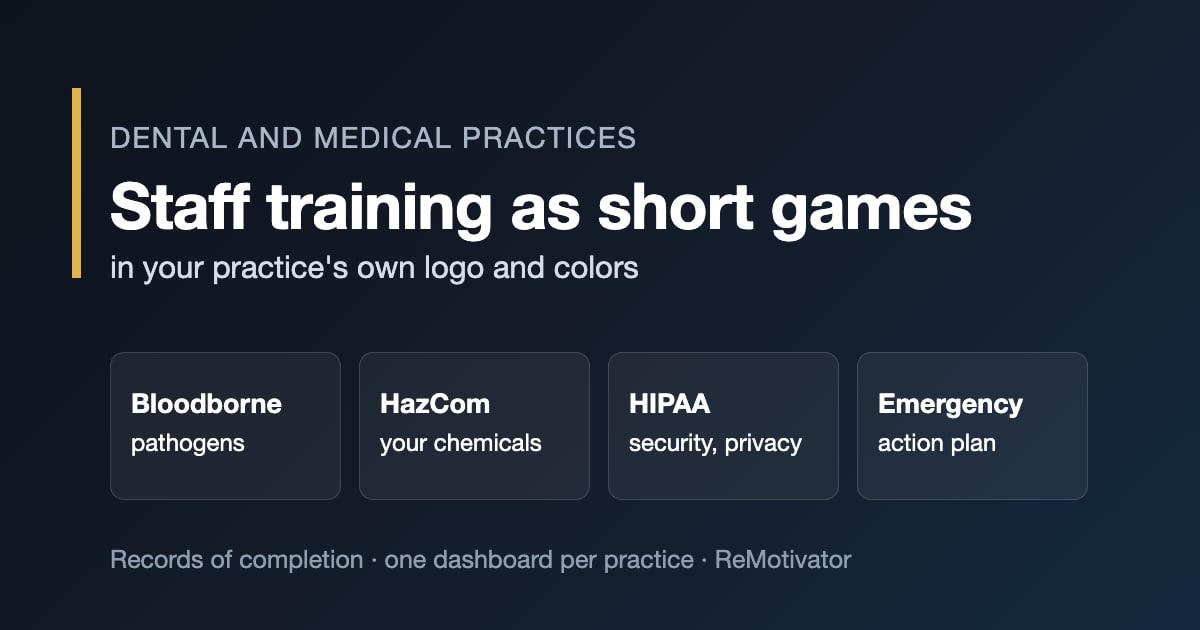
OSHA’s bloodborne pathogens standard, 29 CFR 1910.1030(g)(2), requires employers to train every employee with occupational exposure, at no cost, at initial assignment and at least once a year. Clean Hands is a 20–25-minute online training game in your practice’s brand that covers the fourteen required elements, A to N, with questions answered by a qualified trainer. Passing the quiz (8 of 10) gives a record of completion.
Supports your training requirement under OSHA 29 CFR 1910.1030(g)(2).
Not an OSHA card. This is not the OSHA 10- or 30-hour Outreach program, and OSHA does not issue bloodborne pathogens, hazard communication or emergency action plan certificates.
Try it with your practice’s logo
Type your practice’s website: we read your logo and colors and open a free 5-minute game in your brand. The training games use the same branding.
Reading your website
Finding your logo
Your brand: name, colours, values
Building your world
Lots of people are making their games right now.
You're in line. Keep this page open: yours starts by itself.
This taste is one of our team games in your colors. Your staff’s training games carry the same logo and colors.
Works on your phone too: turn it sideways. Or send yourself the link for a bigger screen.
The demos are set at companies we made up (Harborview Software, Bayside Family Dental); your games use your practice’s brand and details.
Bloodborne pathogens training: what the standard requires
OSHA’s bloodborne pathogens standard, 29 CFR 1910.1030, applies to every employer whose employees have occupational exposure: contact with blood or other potentially infectious materials that can reasonably be expected in their job. In a dental office that usually includes dentists, hygienists, assistants and the staff who clean instruments and operatories.
The employer must provide training at no cost to the employee and during working hours (1910.1030(g)(2)(i)). The training must cover fourteen elements, listed as (A) to (N) in 1910.1030(g)(2)(vii), use content and vocabulary that fit the staff’s education, literacy and language (1910.1030(g)(2)(vi)), and be conducted by a person who knows the subject as it relates to the workplace (1910.1030(g)(2)(viii)).
This page is for employers: seats for your staff, the roster and each person’s due date. One person who needs a certificate for themselves buys a single seat on the bloodborne pathogens certification page.
Who must be trained, and how often
Who: every employee with occupational exposure (1910.1030(g)(2)(i)). Front-desk staff who never handle instruments or patients may not have occupational exposure; your Exposure Control Plan lists the job classifications that do. You tell us which roles have exposure.
When: at the time of initial assignment to tasks where exposure may take place, and at least annually after that (1910.1030(g)(2)(ii)).
Within a year: each annual training must be within one year of the person’s previous training (1910.1030(g)(2)(iv)). The dashboard keeps a due date for each person.
When tasks change: additional training when new or changed tasks or procedures affect a person’s exposure; it may cover only the new exposure (1910.1030(g)(2)(v)).
What records must be kept
Training records must include (1910.1030(h)(2)(i)):
the dates of the training sessions;
the contents or a summary of the training;
the names and qualifications of the persons conducting the training;
the names and job titles of everyone who attended.
They must be kept for 3 years from the date of the training (1910.1030(h)(2)(ii)). The records of Clean Hands carry all four items, plus the score, the edition of the game and the next due date for each person. You export them as CSV and as a roster PDF and keep them with your plan.
What the game covers, element by element
The training elements of 29 CFR 1910.1030(g)(2)(vii), in plain words, and where Clean Hands covers each
Element
What the training must cover
Where in Clean Hands
(A)
Access to a copy of the text of the bloodborne pathogens standard, and an explanation of what it says.
The Front Office
(B)
A general explanation of the epidemiology and symptoms of bloodborne diseases.
The Front Office
(C)
An explanation of how bloodborne pathogens are transmitted.
The Lab / Clean-up
(D)
An explanation of the practice’s Exposure Control Plan and how to get a copy of the written plan.
The Front Office
(E)
How to recognize tasks and other activities that may involve exposure to blood and other potentially infectious materials.
The Operatory
(F)
How engineering controls, work practices and personal protective equipment prevent or reduce exposure, and their limits.
The Operatory
(G)
Personal protective equipment: the types, proper use, where it is kept, how to remove, handle, decontaminate and dispose of it.
The Operatory
(H)
Why a given piece of personal protective equipment is chosen for a task.
The Operatory
(I)
The hepatitis B vaccine: how well it works, its safety, how it is given, its benefits, and that it is offered free of charge.
The Front Office
(J)
What to do, and whom to contact, in an emergency involving blood or other potentially infectious materials.
The Needlestick
(K)
What to do if an exposure incident happens, including how to report it and the medical follow-up that will be available.
The Needlestick
(L)
The post-exposure evaluation and follow-up the employer must provide after an exposure incident.
The Needlestick
(M)
The signs, labels and color coding the standard requires.
The Lab / Clean-up
(N)
A chance to ask questions and get answers from a knowledgeable person who conducts the training.
Ask the trainer
The elements are paraphrased, not quoted. Elements D and J–L use your practice’s own details (where the plan is kept, the incident contact, the vaccine contact), which you give us at setup.
The bloodborne pathogens training course: four rooms and Ask the trainer
Exposure, controls and protective equipment
The Operatory
The treatment room: which tasks can expose you to blood or saliva, what engineering controls and work practices do (and where they stop), and choosing, wearing and removing protective equipment.
Elements E, F, G, H
How pathogens spread; labels and color coding
The Lab / Clean-up
Clean-up and the lab: how bloodborne pathogens are transmitted, and the biohazard labels, signs and color coding you will see on containers and waste.
Elements C, M
Exposure incidents and follow-up
The Needlestick
A sharps injury: what to do first, whom to tell in your practice, how the incident is reported and the medical evaluation and follow-up the practice provides.
Elements J, K, L
The standard, the diseases, your plan and the vaccine
The Front Office
Where the standard’s text and your Exposure Control Plan are kept, the basics of the bloodborne diseases, and the hepatitis B vaccine your practice offers at no cost.
Elements A, B, D, I
Element N: Ask the trainer
A question button sits in the game and on the completion page. Every question goes to a qualified trainer, who answers within one business day; the trainer is named on your certificate and record, and each question and answer is logged on it.
The trainer of record is ours or yours: you choose at setup. A practice can also book an optional 15-minute live Q&A session with the trainer for its staff.
OSHA’s letters of interpretation on computer-based training stress that trainees should be able to get answers from a knowledgeable person. If you want questions answered while staff play, book the live session for the same time, or name your own trainer of record who is available then.
About 20–25 minutes, solo, on a laptop or a phone, nothing to install. Then a 10-question quiz: 8 right to pass, unlimited retakes, the best score is kept.
What the game does not cover
The hepatitis B vaccination itself. The game explains the vaccine (element I); offering it and keeping the vaccination records (1910.1030(f)) is the practice’s job.
Your written Exposure Control Plan. The game tells staff where it is kept and what it is for (element D); writing it and reviewing it every year (1910.1030(c)) is the practice’s job.
The sharps injury log. The game shows how an injury is reported; keeping the log (1910.1030(h)(5)) is the practice’s job.
What you give us (about 5 minutes)
Your brand: practice name, logo and colors (we read them from your website; you check them).
Your plan: where your Exposure Control Plan is kept.
Your contacts: the person to tell after an exposure incident, and the contact for the hepatitis B vaccine.
Your trainer of record: ours, or yours with their name and qualifications.
Exposure: which roles in your practice have occupational exposure.
Nothing else: no patient information, no logins, no installs. You type every name.
Price
Prices in US dollars.
Single seat
$29
One person, one game: Clean Hands (bloodborne pathogens) or Label Reader (HazCom). A completion certificate when you pass; checkout by card, only an email address needed. A single seat uses the industry example set, not your workplace’s own list, and the certificate says so.
Pair
$49
One person, both games: bloodborne pathogens and HazCom, a certificate for each.
Practice or team
from $349/yr
The Practice Compliance Pass: four games, $29 per staff member per year, minimum $349 per practice, with your own chemical list, the dashboard, due dates and the roster. The Practice Compliance Pass
Single-seat checkout opens soon: leave your email and we send you the link.
A sample record of completion and the roster
Sample: a fictional practice and person
Bloodborne Pathogens Training — Record of Completion
Name
Jane Doe
Job title
Dental assistant
Practice
Bayside Family Dental (fictional)
Date
November 3, 2026
Score
9 / 10 (passed)
Contents
Bloodborne pathogens: elements (A)–(N) of 29 CFR 1910.1030(g)(2)(vii); questions asked: 1, answered
Trainer of record
named on your certificate
Edition
Clean Hands, 2026
Next training due
by November 3, 2027
Every record is a PDF; the person downloads it at the end, and you get all of them in the report.
The roster
One row per staff member: the job title, and for each game the date completed, the score, the trainer of record and the next due date (for Label Reader, the version of your chemical list it used). Completion % per game at the top. Export as CSV, or as a roster PDF to keep with your records.
Sample roster (fictional names)
Name (sample)
Job title
Clean Hands
Label Reader
Escape the Breach
Clear the Floor
Jane Doe
Dental assistant
Done Nov 3, 2026 · due Nov 3, 2027
Done Nov 3, 2026 · list v2
Done Nov 4, 2026
Due Dec 1, 2026
John Doe
Hygienist
Due Nov 20, 2026
Due Nov 20, 2026
Done Oct 30, 2026
Done Nov 2, 2026
Sam Doe
Front desk
Not assigned (no exposure)
Not assigned (no chemicals)
Done Nov 1, 2026
Done Nov 1, 2026
Sample only: Bayside Family Dental, Jane Doe, John Doe and Sam Doe are made up. The data we keep: staff names, job titles, scores and dates; no patient information is ever stored.
Questions
How long is a bloodborne pathogens certification good for?
OSHA asks for bloodborne pathogens training at least once a year, each time within one year of the last (29 CFR 1910.1030(g)(2)(ii) and (iv)), so a certificate is usually treated as good for one year. Ours shows the date to refresh by. An employer can set its own rule.
Is online bloodborne pathogens training allowed?
Yes, if it covers elements A–N of 29 CFR 1910.1030(g)(2)(vii), and trainees can ask questions of a knowledgeable person (element N). OSHA’s letters of interpretation say self-paced training alone is not enough without that. Clean Hands has the Ask the trainer path, and you can book a live 15-minute Q&A session.
How often does our staff need bloodborne pathogens training?
At initial assignment to tasks with occupational exposure and at least annually after that (1910.1030(g)(2)(ii)), each time within one year of the last training (1910.1030(g)(2)(iv)), plus additional training when new or changed tasks affect a person’s exposure (1910.1030(g)(2)(v)). The dashboard keeps each person’s due date.
Who is the trainer of record?
Ours or yours: you choose at setup. The trainer’s name and qualifications are on every record, as 1910.1030(h)(2) asks; a qualified trainer answers the staff’s questions within one business day.
What records do we get?
A record of completion per person (“Bloodborne Pathogens Training — Record of Completion”) with the date, a summary of the contents, the trainer’s name and qualifications, the person’s name and job title, the score and the next due date; a CSV export and a roster PDF. Keep them for 3 years (1910.1030(h)(2)(ii)).
What does it not cover?
The hepatitis B vaccination itself, your written Exposure Control Plan and your sharps injury log. The game explains each one and tells staff where to find yours; the practice provides and keeps them.
Does finishing the game cover everything the rule asks of us?
No. Your practice, as the employer, remains responsible for its bloodborne pathogens program: the written Exposure Control Plan, the hepatitis B vaccination, the sharps injury log, deciding who has occupational exposure, and keeping the training records. The game delivers and records the training part.
What information do you keep about our staff and patients?
Staff names, job titles, scores and dates, so the records and the roster work. No patient information is ever entered or stored: the games use made-up patients and situations.
How do we pay?
By card, or by purchase order and invoice. We send a quote first. The Practice Compliance Pass is $29 per staff member per year, minimum $349 per practice; $24 per seat for groups of 10 or more locations.
Does OSHA certify trainers or issue certificates?
No. OSHA does not certify trainers, and it does not issue bloodborne pathogens, hazard communication or emergency action plan certificates. Under these standards the employer trains its employees and keeps the records; a certificate of completion from a course shows that the training happened. The only OSHA cards are those of the voluntary Outreach Training Program (10- and 30-hour courses taught by trainers OSHA has authorized); this is not that program.
Your program stays yours. Your practice, as the employer, remains responsible for its bloodborne pathogens program: the written Exposure Control Plan, the hepatitis B vaccination, the sharps injury log, deciding who has occupational exposure, and keeping the training records.
Supports your training requirement under OSHA 29 CFR 1910.1030(g)(2). The regulations on this page are paraphrased; read the full text before you rely on it. This page is general information, not legal advice. ReMotivator is not affiliated with or endorsed by OSHA or the U.S. Department of Labor.