Where hazardous chemicals are
The Supply Closet
Find the hazardous chemicals among the ordinary ones, on a shelf stocked from your own chemical list, and where your written hazard communication program and chemical inventory are kept.

Label Reader · OSHA hazard communication training
OSHA’s Hazard Communication Standard, 29 CFR 1910.1200(h), requires employers to train employees who may be exposed to hazardous chemicals, when they are first assigned and whenever a new chemical hazard enters their work area. Label Reader is a 15–20-minute online game in your brand: labels and GHS pictograms, safety data sheets, a spill and protective measures. Passing the quiz (6 of 8) gives a completion certificate.
Supports your training requirement under OSHA 29 CFR 1910.1200(h).
Not an OSHA card. This is not the OSHA 10- or 30-hour Outreach program, and OSHA does not issue bloodborne pathogens, hazard communication or emergency action plan certificates.
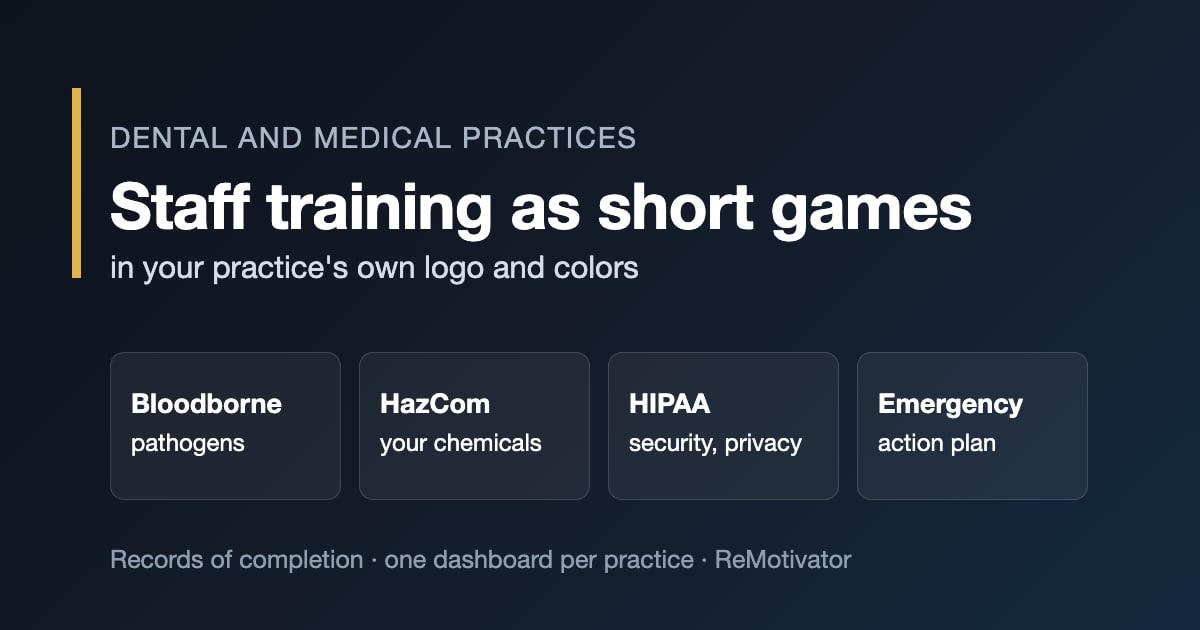
Type your organization’s website: we read your logo and colors and open a free 5-minute game in your brand. The training games use the same branding.
Lots of people are making their games right now.
You're in line. Keep this page open: yours starts by itself.
This taste is one of our team games in your colors. Your staff’s training games carry the same logo and colors.
Works on your phone too: turn it sideways. Or send yourself the link for a bigger screen.
The demos are set at companies we made up (Harborview Software, Bayside Family Dental); your games use your organization’s brand and details.
OSHA’s Hazard Communication Standard, 29 CFR 1910.1200, gives employees the right to know about the hazardous chemicals they work with. Manufacturers and importers classify chemicals and supply labels and safety data sheets; employers keep a written hazard communication program, keep the sheets available and train their employees.
Under 1910.1200(h)(1), employers give employees information and training on the hazardous chemicals in their work area at their initial assignment and whenever a new chemical hazard is introduced. The training may cover categories of hazards (for example flammables or corrosives) rather than each chemical.
Paraphrased from 29 CFR 1910.1200(h). Read the full text on eCFR.
29 CFR 1910.1200 does not set a record-keeping rule or a retention period for the training. A dated record is still the simplest way to show that each person was trained.
Label Reader gives each person who passes (6 of 8) a completion certificate with their name, the date, the score and the trainer of record; the report adds the roster as CSV and PDF.
| Section | What the training must cover | Where in Label Reader |
|---|---|---|
| (h)(2)(i) | The requirements of the hazard communication standard. | The Supply Closet |
| (h)(2)(ii) | The operations in the work area where hazardous chemicals are present. | The Supply Closet |
| (h)(2)(iii) | Where the written program, the list of hazardous chemicals and the safety data sheets are kept. | The Supply Closet; The SDS Binder |
| (h)(3)(i) | How to detect the presence or release of a hazardous chemical (monitoring, appearance, odor). | The Spill |
| (h)(3)(ii) | The physical, health and other hazards of the chemicals in the work area. | The Label |
| (h)(3)(iii) | How employees protect themselves: work practices, emergency procedures, protective equipment. | The Spill; The SDS Binder |
| (h)(3)(iv) | The employer’s program: labels, the workplace labeling system, safety data sheets and how to get and use them. | The Label; The SDS Binder |
Where hazardous chemicals are
Find the hazardous chemicals among the ordinary ones, on a shelf stocked from your own chemical list, and where your written hazard communication program and chemical inventory are kept.
GHS pictograms and labels
Match the nine GHS pictograms to their hazards, read a label (signal word, hazard and precautionary statements, supplier) and fix a secondary container with no label.
Safety data sheets
The 16 sections of a safety data sheet: find the one that answers each question (first aid, protective equipment, spills, storage), and where your sheets are kept.
Detecting a release; protecting yourself
Notice a release by odor, appearance or monitoring, choose the protective equipment, follow the spill and emergency procedure and tell the right person.
About 15–20 minutes, solo, in your brand, with a learn card after each room. Then an 8-question quiz: 6 right to pass, unlimited retakes. Based on OSHA’s hazard communication standard and its public briefs on labels, pictograms and safety data sheets.
The 2012 update of the standard aligned US labels and safety data sheets with the Globally Harmonized System (GHS): nine pictograms, a signal word (Danger or Warning), hazard and precautionary statements, and safety data sheets in sixteen sections in a fixed order. The Label room is the GHS training; the SDS Binder room is the SDS training.
Your chemicals: the Supply Closet, the label puzzles, the SDS Binder and the spill use your own list. This is the list you give us for training examples. It is not a chemical inventory audit; your written hazard communication program and inventory remain yours.
Prices in US dollars.
Single seat
$29
One person, one game: Clean Hands (bloodborne pathogens) or Label Reader (HazCom). A completion certificate when you pass; checkout by card, only an email address needed. A single seat uses the industry example set, not your workplace’s own list, and the certificate says so.
Pair
$49
One person, both games: bloodborne pathogens and HazCom, a certificate for each.
Practice or team
from $349/yr
The Practice Compliance Pass: four games, $29 per staff member per year, minimum $349 per practice, with your own chemical list, the dashboard, due dates and the roster. The Practice Compliance Pass
For one organization, Label Reader in your brand, your own chemical list included: setup, branded $500 once, then $19 per person, from $199 per run. Running it again costs the per-person price only.
Single-seat checkout opens soon: leave your email and we send you the link.
Sample: a fictional person
One row per person: the job title, the date completed, the score, the trainer of record and the next due date, with a summary at the top. Export as CSV or PDF.
| Name (sample) | Job title | Completed | Score | Suggested next review |
|---|---|---|---|---|
| Jane Doe | Office manager | Nov 3, 2026 | Passed | Nov 3, 2027 |
| John Doe | Coordinator | Nov 4, 2026 | Passed | Nov 4, 2027 |
| Sam Doe | Assistant | — | — | Not started |
Sample only: Jane Doe, John Doe, Sam Doe and Bayside Family Dental are made up. The data we keep: names, job titles, scores and dates; no patient information is ever stored.
Under 29 CFR 1910.1200(h): where hazardous chemicals are in your work area, where the written program and safety data sheets are kept, how to detect a release, the hazards of the chemicals, how to protect yourself, and how to read labels and safety data sheets.
At initial assignment and whenever a new chemical hazard is introduced into the work area (1910.1200(h)(1)). The standard sets no yearly schedule; many employers retrain every year as their own policy.
The standard does not say how training is delivered. It must cover the content in 1910.1200(h) and your own program and chemicals, and employees should be able to ask questions. Label Reader uses your program location, safety data sheet location, emergency contact and your own chemical list.
Training on the Globally Harmonized System labels and safety data sheets that US labels follow since the 2012 update: the nine pictograms, the signal words and the hazard and precautionary statements. Label Reader’s Label room covers it.
Learning what each of the sixteen sections of a safety data sheet tells you and where your workplace keeps them. Label Reader’s SDS Binder room covers it.
Not from OSHA. A HazCom certificate is a certificate of completion from a training course; Label Reader gives one when you pass the quiz.
No. Your organization, as the employer, remains responsible for its hazard communication program: the written program, the chemical inventory, the safety data sheets, workplace labels, and training on chemicals specific to your work areas. The game delivers and records the training part.
No. OSHA does not certify trainers, and it does not issue bloodborne pathogens, hazard communication or emergency action plan certificates. Under these standards the employer trains its employees and keeps the records; a certificate of completion from a course shows that the training happened. The only OSHA cards are those of the voluntary Outreach Training Program (10- and 30-hour courses taught by trainers OSHA has authorized); this is not that program.
Yes. Type your website at the top of this page to see a free 5-minute game in your logo and colors, or play the demo of a game (it opens the game itself). Harborview Software and Bayside Family Dental are companies we made up to show the games.
Your program stays yours. Your organization, as the employer, remains responsible for its hazard communication program: the written program, the chemical inventory, the safety data sheets, workplace labels, and training on chemicals specific to your work areas.
Supports your training requirement under OSHA 29 CFR 1910.1200(h). The regulations on this page are paraphrased; read the full text before you rely on it. This page is general information, not legal advice. ReMotivator is not affiliated with or endorsed by OSHA or the U.S. Department of Labor.
Bloodborne pathogens certification · Bloodborne pathogens training · OSHA training online · Emergency action plan training · HIPAA compliance training online · Dental practice training · All training games
Tell us how many staff and locations, and when your training is due. We reply within one working day.